Showing posts with label Port Melbourne history. Show all posts

Thursday, November 28, 2013

'A sodden expanse' - Fishermans Bend

PMHPS continues to be preoccupied with Fishermans Bend. In the late 1930s Fishermans Bend was on the cusp of a major transformation to industrial development - a change that was anticipated with excitement and optimism. Charles Daley in The History of South Melbourne says:
'The once-despised Fishermen's Bend - a no-man's land - under the pressure of economic circumstance, has come into its own, and its sodden expanse bids fair, under the exercise of human knowledge, skill and labour, directed to its reclamation, to provide eventually scope for great projects and undertakings conducive to the advantage of the State.
In this long-neglected and unoccupied area of 'Siberia,' ... great activity and interest have been aroused. On 5th November, 1936, occurred on, the north side of 'The Bend,' the opening of the great and extensive factory for motor construction of the noted firm of General Motors-Holden's, whose enterprise has set the example for other leading industrial ventures and subsidiary factories.
The Aircraft Factory ... in which the Broken Hill Proprietary, Imperial Chemical Industries and General Motors Companies are jointly concerned, has been established, and many applications have been made for leases on what must become a manufacturing area of great importance, giving employment to thousands of workmen.' (p344)
Rootes Factory in Salmon St
Harold Paynting Collection State Library of Victoria

The photograph above shows the Rootes factory under construction. The extensive plant covered almost an entire block and became the headquarters for manufacture of aircraft (principally the Beaufort bomber) by the Department of Aircraft Production during WWII. It reverted to car manufacture after the war.*

Source
*Port Melbourne Walk booklet produced but the Art Deco & Modernism Society 

Three . . . of Port

Sometimes you just can't find the right word. Take icon, for example. Many Port Melbourne people have had enough of the word 'icon'. 'Iconic' as new developments are often described, is almost guaranteed to get people's backs up.
But back to Port. In this photograph, three Port (what word would you use?): the beacon, the newly restored Stothert & Pitt crane and the chimney of Harpers Starch Factory. Icons of Port. They so clearly show how history gives meaning and identity to a place. At one time, the Starch Factory chimney was the landmark, but as this photo shows, it is now dwarfed by the hmas apartments.
the beacon, the crane and the chimney
Stothert & Pitt were 'cranemakers to the world', based in Bath, a place more usually associated with Jane Austen. The two 3-ton Stothert and Pitt electric wharf cranes with 80 foot operating radius were erected at the outer end of Station Pier in 1949.
The Jubilee History of the Melbourne Harbor Trust shows these cranes on Station Pier in a 1927 photograph - an earlier type?

from the Jubilee History of the Melbourne Harbor Trust
Corrections and additions always welcome.


Thursday, November 14, 2013

Fishing business

Dugga Beazley
In the late 1980s, with great change looming in Port Melbourne, Dugga Beazley spoke to documentary maker Richard Crawley of his fear that a time might come when he would no longer be able to run his fishing business from Dow St. That time seems to come every few years when newcomers complain about his business or his trailer. Once again, his operation is under threat after the Council's crackdown on trailers being kept on the street.
The Beazleys have fished in Port Melbourne since the earliest days of white settlement. Dugga Beazley knows the Bay like few people alive know the Bay - its fish, its winds, its currents, its moods. He knows details about the history of the Bay - the storms, the wrecks, the boats. He has been fishing since he was 13 years old - 60 years on the Bay.
He is a very proud Australian, and one of his proudest moments was leading the flotilla of boats up the Yarra River for the Commonwealth Games.
We invest heavily in protecting our built heritage but don't seem to have the means of celebrating and protecting our living heritage. We should be nominating Dugga as a living treasure rather than hounding him off the street. Keep him on the street where he can share those stories rather than locking him away behind a wall. We have so much to learn from him - lived knowledge you can't find on an iPad or in a book.
Every boat he paints has a story – many that begin right here in Port. Once he was painting The Volunteer. 
The Volunteer was built by Jesse William Merrington at 121 Liardet Street* around 1920 and 21. It was originally owned by the Merrington brothers before being sold to George Beazley. Merrington's boat shed was located on the shores of the Sandridge Lagoon** A further boat, The Enterprise was built off the moulds of The Volunteer at 41 Nott St, Port Melbourne during mid 1930.
'Oo roo' as Dugga would say.
Sources
Re-Living the Early Days, The Age 2 February 1935
Ida Campbell writes in (an unnamed) newspaper 27 January 1983
Dugga Beazley
* also known as Kyme Place
**where the pumping station is now on Esplanade West

Sunday, November 3, 2013

A Melbourne Cup Special

Melbourne Cup Day prompts this recollection from member Helen Barry:

“Mum was a milliner. She was busiest at racing time. I always went to the Melbourne Cup with her. We used to walk past the members’ enclosure trying to spot the hats she had made.”

Rose with her future husband, Norman Barry 
"Rose Welsh began her apprenticeship as a milliner at Susanne et Cie at 179 Collins St, Melbourne in 1925.  She was lured by the high class milliner Thomas Harrison, known as ‘the Czar of the Millinery world’ to his shop and workroom at De Vere et Cie, the Block Arcade, 262 Collins Street. She became ‘head of the table’ as they called it. She worked with him for ten years until she married.  By the time she left De Vere she was the overseer of the girls making the hats and regarded as a leader in her profession.  Thomas Harrison held her in high esteem and presented her with a silver tea and coffee service on a large silver tray which was openly displayed in the showroom of De Vere for the customers to admire. She used to take hats in hat boxes on the cable trams to customers through the city. On one occasion, she stitched a hat to a client's head using her hair. It was to look as though the wind had blown it onto her head.

After her marriage Rose - now Barry - worked from home for Lola Canning in the Block Arcade. She made hats from her Garden City home well into her 80s. Her last employer was Wendy Mead who worked out of Toorak. She made hats for Lillian Frank and Pixie Skase. Wendy Mead would tear out a page with a hat on it from Vogue and Mum would then make it. Many a hat was shaped around this wooden block. After mum had made the hats, dad would deliver them.”
Explore further
Visit the National Gallery of Victoria's on-line gallery of the hats of Thomas Harrison. Rose Barry's hand may well have been at work in some of those hats http://www.ngv.vic.gov.au/col/artist/9610

Monday, October 28, 2013

Allan Whittaker Memorial Commemoration

Update 3 November 2013
At sunset people gathered at Princes Pier to commemorate the life of Allan Whittaker, shot by police in the waterfront dispute in 1928. Kevin Bracken emphasised the importance of getting together to tell the stories of the place and the people that have shaped Port Melbourne. 
Former Supreme Court Judge Frank Vincent, who was born into a waterfront family in Port Melbourne in the thirties gave an impressive address - all without notes. Here is a brief excerpt from his speech (for more, click here)

 Frank Vincent, born in Port Melbourne
"But the remarkable thing about what occurred at that time, and which is not simply the story of one man, is that there was a bonding, a linkage between those people who remained with the Waterside Workers Federation in the very, very difficult period of almost twelve years that followed that particularly shooting.  Because quite a few defected. Quite a few left the industry entirely.
Those that remained, those that lived in this area of Port Melbourne, formed a very very powerful community and a community that had its effect right across our industrial scene for the many years that followed.
I don’t think anyone should underestimate the significance of the struggles which occurred at that time. The courage that it took for men and women to hold together when they could easily have joined a scab union and defected and given away their principles and given away their community.But they didn’t do that. And it took a very special kind of courage and it ought to be memorialised, it ought to be understood, we ought to be inordinately proud of it.
There are lots of things in our Australian history of which we should be massively ashamed - some of them are occurring at the present time - but this is certainly not one of them."


The Allan Whittaker Memorial Commemoration will be held at Princes Pier on Friday 1st November at 6.15 p m.
The commemoration will mark the 85th anniversary of the 1928 Dock Strike and fatal shooting by police of Allan Whittaker, a waterside worker and Gallipoli veteran.
The commemoration will feature talks as well as the sunset presentation of memorial items to commemorate Allan Whittaker, his fellow waterside workers and rich maritime industrial history.
(PMHPS warrants that this is a photograph taken of a notice about the Whittaker commemoration and is not contrived)

Friday, September 6, 2013

Tall Ships Festival: 6 to 15 September

The Tall Ships Festival starts today with ships coming through the Heads and arriving in Williamstown tomorrow.
The Tall Ships came to Port Melbourne in 1988 for the Bicentenary Celebrations which were launched nationwide on New Year's Eve at Princes Pier by Prime Minister Bob Hawke. A quarter of a million people visited the Tall Ships over the week they were in Port.
The visit of the Tall Ships is an opportunity to revisit that exciting week in Port, and to get a sense of the foreshore before Beacon Cove.

Cranes on Station Pier, Tall Ship and pylon at the western end of Centenary Bridge 
viewed from the driveway of the Mission to Seamen building
One of the cranes is soon to be re-instated at the finger pier next to Station Pier
photo Alison Kelly PMHPS collection

The Mission to Seamen building,
demolished in 1995
photo Alison Kelly PMHPS Collection

Crowds flow across Centenary Bridge after viewing the Tall Ships
The Bridge was demolished in 1991
photo Alison Kelly PMHPS Collection


Thursday, September 5, 2013

The History of Melbourne Ports

Electorate of Melbourne Ports
Existing since Federation, Melbourne Ports has been held by the Labor Party since 1906 and has had only five members in 107 years since. Former Labor members are 

Jim Matthews 1906 - 1931
E J Holloway 1931 - 1951
Frank Crean 1951 - 1977
Clyde Holding 1977 - 1998
Michael Danby since 1998

Source:  ABC, Anthony Green's Election Guide 
http://www.abc.net.au/news/federal-election-2013/guide/mpor/

Random post about dogs

There is something in the Society's collection for every interest. A leather bound alphabetical index book lists all dogs registered in Port Melbourne in 1892 by owner surname. Even in 1892 there were dogs large and small - from Newfoundlands to poodles. The names of the dogs are not recorded - that would have been revealing.
Port Melbourne Historical and Preservation Society Collection
This undated portrait of Mrs Caroline Liardet as a young woman, before she came to these shores, shows her with a rather surprised looking dog on her lap - is it a King Charles spaniel?  You can see her image as an older woman in our banner picture. 

State Library of Victoria
Caroline Liardet was the  wife of Wilbraham Frederick Evelyn Liardet and mother of their nine children. They arrived in Sandridge on board the William Metcalfe in November 1839.

Port Melbourne plays Williamstown at North Port Oval this weekend. The role dogs play in this old rivalry is amusingly told here.  As you can see, no dogs are allowed but that rule was apparently flouted by a President of the Williamstown Football Club.
Any dog tales out there? 

Friday, August 30, 2013

Port Melbourne's History On Display

In one week, The Borough and Its People: Port Melbourne 1839 to 1939, by members Margaret and Graham Bride has been spotted on display at the State Library of Victoria, the Port Melbourne Library and the Prahran Mechanics Institute Victorian History Library. Congratulations!
At the State Library
At the Port Melbourne Library
At the Prahran Mechanics Institute Victorian History Library

Wednesday, August 28, 2013

The Great White Fleet and Port Melbourne

In Melbourne from 29 August to 5 September 1908
President Roosevelt commissioned 16 new battleships between 1904 and 1907. He sent them on a 15 month goodwill visit around the world. Prime Minister Deakin invited them to visit Australia. The young Australia was feeling exposed following the defeat of the Russian Navy by Japan in 1905. The British Navy had withdrawn their warships from the Pacific. The visit was a formative step in the relationship between the US and Australia. The popular support and the excitement generated by the visit gave an impetus to the subsequent establishment of the Royal Australian Navy in 1911.
The ships' hulls were painted white, except for the gilded scrollwork with a red white and blue banner on their bows. Fourteen thousand sailors came to town. Melbourne was in a fever of excitement. The sailors made their entrance to Melbourne via Port Melbourne's Town Pier. Crowds lined the entrance to the Pier as the sailors set off to parade to Melbourne for the week long celebrations.

The Bride's write: 'They arrived in Port Melbourne, where they were greeted with great enthusiasm and given a formal Entry to the City at the Town Pier. The ships were anchored in the Bay. On the day of their arrival, thousands of people crowded around the foreshore to watch. The Standard considered this to be a truly wonderful day:
'Last Saturday was no doubt one of the greatest days in the history of Port Melbourne, and proved once again that whatever the desire of those in high places to treat this town with contempt, the general public recognise that it is a favourite place of resort, when anything of interest in the maritime world stirs the great heart of the people.' (1)
There is much much more of this story to explore via the links below.
Notes
Town Pier was built in 1849, where Liardet's jetty had been, at the southern end of Bay St.
(1) M and G Bride The Borough and Its People: Port Melbourne 1839 to 1939, p239
Links to further information
http://prov.vic.gov.au/blog-on
http://museumvictoria.com.au/melbournemuseum/whatson/exhibition-archive/great-white-fleet/ly/great-white-fleet-105-years-on

Thursday, August 22, 2013

Port Melbourne Historical and Preservation Society celebrates 20 years

Port Melbourne Historical and Preservation Society AGM 
What tales have been told, what stories recorded in that time! A chronicle of the work packed into those twenty years and the companionship enjoyed along the way will be documented in the Annual Report. The impressive number of publications created over the time are available for sale from the PMHPS website. 
Those publications weave into the larger Victorian and Australian story. Members Margaret and Graham Bride's recent publication The Borough and Its People: Port Melbourne 1839 to 1939 was observed today on display under the dome at the State Library of Victoria.

Dr Miles Lewis is the guest at Monday's AGM. Dr Lewis was a sub-consultant on the 1979 Port Melbourne Conservation Study commissioned by the Port Melbourne City Council and the Australian Heritage Commission which laid the foundation for the protection of heritage areas in Port Melbourne. Dr Lewis is an architectural historian and Professor in the Faculty of Architecture, Building and Planning at the University of Melbourne. The breadth and depth of is his research interests and publications is revealed on his website.

The Annual General Meeting will be held upstairs at the his Melbourne Town Hall at 333 Bay St on Monday 26 August from 7.30 pm followed by supper.


Thursday, August 15, 2013

For National Science Week: The CSIRO in Port Melbourne

This post is a fragment of a huge story. Fishermans Bend has a very strong association with science and innovation and their application to industry and manufacturing. CSIRO, Australia's national science agency, was a very significant presence in Port until the eighties.
In 1938, CSIR as it was then known, leased 5.9 hectares of land at Fishermans Bend from the Government. At one time, CSIRO employed over 600 people at Fishermans Bend. Even though CSIRO acquired the Clayton site in 1959, the move from Port Melbourne was gradual. With the Fishermans Bend site too small to accommodate CSIRO's range of research activities, from 1964 the CSIRO Minerals Division moved to the former BALM Paint factory at 399 Williamstown Road. It was only vacated in 1989.
former BALM Paint Factory
399 Williamstown Road, formerly the Minerals Divison of CSIRO
'The research of the Minerals Division was directed towards assisting the development of new, and the improvement of existing methods of mineral processing through the application of continually developing expertise in physical and inorganic chemistry related to minerals. This scientific base enabled it to advance to to technology in areas such as environment and energy.' (Commonwealth Government Directory, Vol 2, 1985)
Tantalising snippets of discoveries, innovation and scientific leadership have been gleaned from casual web searches such as 'The 1990 system, a Cray Research Supercomputer Y-MP 2/216, was housed in Port Melbourne and managed by Leading Edge Technologies, which used a share of the system for seismic data processing.' 
It was also a local employer. Just this morning, taking these photos on Williamstown Road I met a man whose father used to be a carpenter at CSIRO. His father never owned a car, since work was just over the road. 
There must be many people who worked for  CSIRO in Port Melbourne and it would be great to hear from them.
Sources and further information
http://artdecobuildings.blogspot.com.au search by BALM 
Encyclopedia of Australian Science


Thursday, August 8, 2013

The Corner Shop

Calling those with stories to share
Port Phillip Council is inviting contributions to the Seniors Writing Awards - due by 2 September. Successful pieces are included in a publication. Here is a small excerpt from a delightful longer poem from the 2010 competition. Its about a corner shop in the Wimmera but it sounds as though it would also describe some of Port's corner shops
"From the levelled drawers behind him would the grocer ladle spice,
With his fingers form a "poke" and tuck it in;
The same for sage or pepper. It was neat, it was precise,
It was never in a packet or a tin!
The paper "poke"!
And when we paid the weekly bill, a poke of peppermints
Or sugar drops or wine gums came our way!"
with permission from George Hall
Only the other day, a Port resident spoke of a 'poke' (and not in a facebook kind of way) and how everyone settled bills on a weekly basis - no matter how much money they had.
This shop was called Bulloughs. John May recalls: 'They sold small goods. I loved going there, thought it was wonderful. It had steps going up to the door, and the counters were all of scrubbed timber.'
Bulloughs, cnr Dow and Graham St
Any shop stories out there?
Sources and further information
Port Melbourne Historical and Preservation Society Calendar 2001
Port Phillip Writes: Tales and Stories 2010: City of Port Phillip (available from the Port Phillip Library Service)

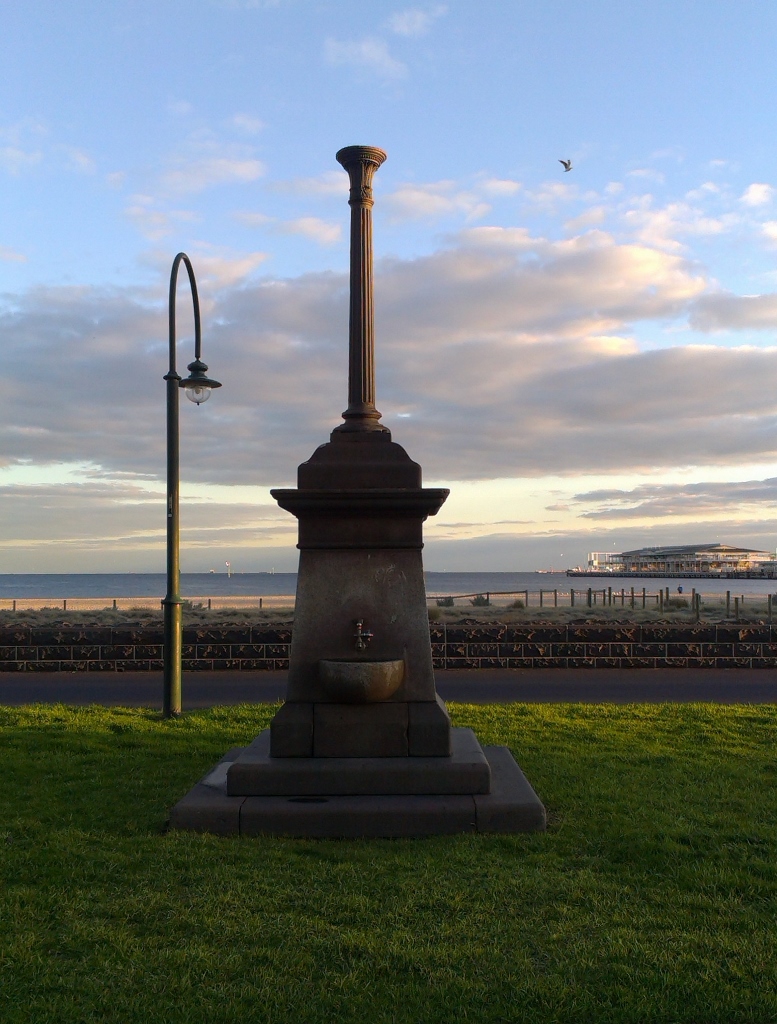
Friday, August 2, 2013

Maskell and McNab

What is a monument to railwaymen doing on the foreshore so far away from trains?

The monument commemorates engine driver Frederick William Maskell and fireman James McNab who, along with three passengers, were killed in a rail accident at Windsor in May 1887. Maskell was 46, McNab 21. One hundred and fifty four people were injured. Mr Maskell was driving an express train when it ploughed into the back of an ordinary train which had broken down just before Windsor Station. Only his presence of mind in pulling on the steam brake of his engine seconds before he was crushed prevented the accident from being much worse. At the subsequent inquest, it was revealed that an untrained station hand was left to apply the steam brake before he and his fireman were killed.
The loss of the two Port Melbourne citizens galvanised a strong local response and fundraising for a memorial soon began.  On Wednesday 16 July 1890, around 350 people, including Mayor Plummer and Councillors, gathered at the unveiling of the monument in Graham St near the the intersection of Station and Princes St.
The monument was re-located to the foreshore when the Graham Street overpass was built. Along with the monument went a mini-community of shops and pubs centred on the rockeries, see image below, which shows that the monument once had decorative features that have since been lost.
PORT PHILLIP CITY COLLECTION
The Maskell and McNab memorial fountain was designed by architect J B Grut. His hand can also be seen in the second storey addition to Chequers/Bay & Bridge as well as the former South Suburban Building Society (currently occupied by SAM Sales and Marketing in Bay St)

Sources and further information
Monument Australia http://www.monumentaustralia.org.au/ lists all monuments in Australia
Railway Rockeries: Tales of the Melbourne and Hobsons Bay Railway Reserves - a Port Melbourne Historical and Preservation Society publication
Trove

Thursday, July 25, 2013

Bits and pieces

A reminder that its Open House Melbourne this weekend. So many places to see - perhaps for the first time. Even if you don't get to visit any of the places, the book that accompanies the weekend is a great resource. There are no Port Melbourne places featured this year. Nearest to Port would be the Mission to Seafarers and the Port of Melbourne boat tours - for which you probably need to book.
Also, for those of you on facebook, Lost Melbourne features new old photos every day. This image of Allens Sweets with Flinders St Station in the foreground is a favourite - topical in this week when designs for the Station were revealed. To vote in the People's Choice for the redesign go to  http://vote.majorprojects.vic.gov.au/

Planning - what's new?

At a time when planning issues are on the minds of Port Melbourne people - (and when have they not been?), PMH&PS was intrigued to find these notes among Swallow & Ariell's archives held at the University of Melbourne.
Over a period of time Swallow & Ariell's factory expanded to include neighbouring properties. Charles Joseph Sarovich, Furrier and Rug Manufacturer conducted his business, and presumably lived at, 77 Beach St.
University of Melbourne Archives
He writes
‘I have heard that you intend building an Electric Bake House on the allotment adjoining my property. I wish to formally protest against this being done.' (June 28 1920)
He continues to press his concern
‘Am I right in presuming you have made your plans so that the light entering my three rooms will not be affected in any way? Otherwise I must object. Taking into consideration the excellent neighbourly feeling which has always existed between us, would it not be advisable to have a quite talk over these matters and try to clear up any differences which may arise later on.' (July 7 1920) 


Thursday, July 18, 2013

'The Food of Great-grandmothers' 2

Margaret Bride continues on the theme of  'The food of Great-grandmothers'
As a further step in debunking the myth about our foremother’s healthy diet I hunted up the reports made by the Port Melbourne Health Inspector to the Central Board of Health in 1887. Let us be grateful for the campaigns that resulted in the regulation of food sales and the effective prosecutions of offenders, and never join in the mindless laughter at jokes about the nanny state.
The Report states: 
 food sold in butchers and grocers is wrapped in newspaper, stained and dirty. Small, ill-ventilated shops sell milk, butter, clothing and groceries all from a shop not properly separated from the shop-keepers dwelling, and frequently also inhabited by dogs, cats and fowls whose urine and excreta come into daily contact with commodities exposed for sale… butchers carts never sell good meat, but dispose of diseased and inedible meat to people anxious to buy it cheaply.
Margaret and Graham Bride are the authors of The Borough and Its People: Port Melbourne 1839 to 1939 which was belatedly featured in the 'local' paper this week

Biscuits, puddings, cakes and more: Swallow & Ariell in Port Melbourne

This week’s post has got to be about Swallow & Ariell.  The Age Epicure devoted this week’s edition  to iconic Australian biscuits without mentioning Swallow & Ariell which operated continuously in Port Melbourne from 1858 to 1991.  PMHPS feels the need to talk biscuits. The former Swallow & Ariell’s factory buildings, now The Anchorage, continue to add interest and pleasure along Stokes, Rouse and Princes Streets.
An unusually pink moment in late afternoon
Thomas Swallow, born in Reading, traveled to California and Ballarat before setting up a business making ships biscuits in Port Melbourne.  His business partner Ariell died in 1877. He then went into partnership with Frederick Derham, his son in law.  This piece is not to dwell on the great civic contribution of both men, but the significant industry they presided over.
The scale of the operation was remarkable. From an early stage, the factory's operations were ‘mechanised to an impressive degree'.  Strategically located next to Port’s piers and the railway, Swallow &  Ariell was a fully integrated business. Company farms around Shepparton provided much of its wheat, and after 1889 most was ground into flour on the Port Melbourne premises. The company sourced fruit and vegetables for canning from farms in Mildura, Mooroopna, Kyabram and Wandin.
‘take  for instance their Muldura apricots and peaches. What a luscious fragrance meets you as the tin is opened and how rich is its glorious colour and how it glistens with the cold white syrup.’
From 1881, Swallow & Ariell owned sugar plantations in Cairns. The sugar was refined into treacle and golden syrup.
For the year ending 1 May 1920, the factory used 51 tons of butter, 2,740 eggs and produced more than 66 lines of biscuits. They also made puddings, elaborate cakes and icecream.
S & A was a significant employer – locally referred to as S&A College. At the height of the South African war it employed 1900 workers but even in 1991 it employed 450 people.

Stokes St, Port Melbourne 1987
Alison Kelly collection: Port Melbourne Historical and Preservation Society
Australian Screen Online hold a promotional film about a (glamourised) day in the life of the Swallow & Ariell factory. It describes the sweet biscuits as ‘the daintiest morsels’, ‘gorgeously coloured’ while the Uneeda biscuit is ‘dried biscuit perfection’. The smell of baking biscuits is a sensory memory many Port Melbourne people share.
Got more information or stories to add? Comment below or send an email 
Sources and further information
Conservation Plan for the Swallow & Ariell Site, Port Melbourne, prepared for the City of Port Melbourne, 1991
Australian Screen Online http://aso.gov.au/ search by Swallow and Ariell
Port Phillip Heritage website images http://heritage.portphillip.vic.gov.au/Home search by Swallow and Ariell
They Can Carry Me Out: Memories of Port Melbourne, available from the PMHPS (see right hand pane)
Swallow and Ariell Biscuit Manufactory workers 1958 http://tinyurl.com/lhnl7kr


Thursday, July 11, 2013

'The Food of Great-grandmothers'

An article in The Age, Epicure of 25 June prompted this response from member Margaret Bride:
In an article on how to eat a healthy diet, I recently read the advice, Don’t eat anything your great-grandmother wouldn’t recognize as food. I think this advice is part of the romantic myth that our grandparents ate a more healthy diet than we do - a diet free from additives.
I do not have any information about the food eaten by my great-grandmother but I do have a Mrs Beeton’s Recipe book that my grandmother, Letty Bellion, used when she lived in Port Melbourne, probably from the time of her marriage in 1889.
One of the advertisements on the cover is for a product Frigiline. Not only was it offered as an additive that would preserve Butter, Fish, Meat, Sausages, Bacon, etc, but there is absolutely no indication of the ingredients that it contained. Another advertisement is for a packaged dry vegetable mixture, again there is no indication of what went into its manufacture.
I think we need to recognize the benefits we enjoy from those campaigners who won the fight to have accurate labeling on products and to be very careful not to believe myths about the purity of the food available to our foremothers.

Margaret Bride
Any readers have any stories about the food of their great-grandparents?

Fishermans Bend - do the maps

On Sunday 7 July, several members of the Society attended a forum on the Future of Fishermans Bend convened by the Community Alliance of Port Phillip. To follow this discussion into the future, it is probably necessary to become familiar with the acronym FBURA for Fishermans Bend Urban Renewal Area. 
Background
On 5 July 2012, the Minister for Planning rezoned a large area of Fishermans Bend to the Capital City Zone.  At 240 ha, the FBURA is bigger than Docklands and Southbank combined. It is the largest urban renewal project in Australia. The rezoning was made without a planning framework of any kind being in place which has led to a rash of speculative development proposals.
Getting clear on Fishermans Bend
To a Port Melbourne person, Fishermans Bend has a particular meaning. It is often locally referred to as 'The Bend'.   But since we are entering a period of public debate, a definition can be useful.  Allan Meiers, in his book Fisherfolk of Fishermans Bend offers this definition: 'Fishermans Bend: A term used by Sandridge Council to designate all the land bounded by the seashore at Hobsons Bay, the northermost bend of the Yarra River and Boundary St which divides South Melbourne and Port Melbourne'
This is well illustrated in the following 1914 map:
 Port Melbourne, Parish of South Melbourne, County of Bourke 1914
State Library of Victoria
All the land shown on the above map was part of the City of Port Melbourne until shortly prior to the amalgamation of local councils in 1994 - including  the northern bump around Coode Island. 

The boundaries of the Fishermans Bend Urban Renewal Area are shown in the coloured hatched sections of the map below. As you can see, it is not the same as the area as conventionally and historically understood to be Fishermans Bend. 

Hope this sheds some light on the matter of Fishermans Bend.

Sources and further information
Allan Meiers Fisherfolk of Fishermans Bend piv
State Library of Victoria  Port Melbourne, Parish of South Melbourne, County of Bourke 1914