Showing posts with label planning. Show all posts

Thursday, December 19, 2013

Cottage on the corner

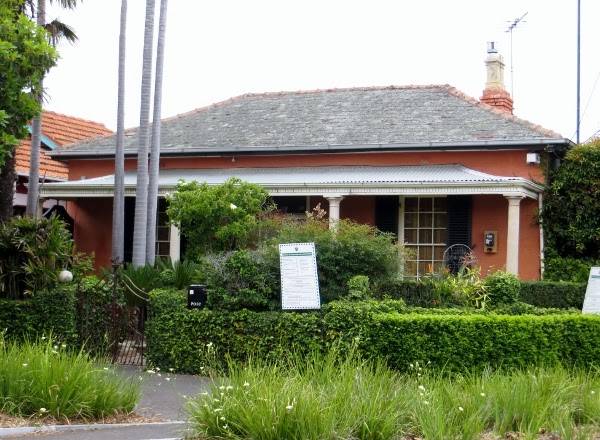
PMHPS has observed a notice of application for a planning permit for this house on the corner of Nott and Farrell Sts, Port Melbourne.
Morley's Cottage: cnr Nott and Farrell Sts, Port Melbourne
This is where William Morley lived. He was the the first chairman of Sandridge when it became a municipality separate from Melbourne in 1860. He was mayor in 1867 and remained a Councillor until his death in 1877. You may have seen his name before - on the Bay St frontage of the former coal store now occupied by South Pacific Gym. Morley was a coal merchant and carter. The coal store, built out of bluestone, gives an indication that Morley was successful businessman.
Read more about Morley, the circumstances of his election and his family life in
The Borough and Its People: Port Melbourne 1839 to 1939 by Margaret and Graham Bride pp 82-84

Wednesday, November 20, 2013

Fishermans Bend - the past and the future

PMHPS's head is spinning with thinking about its submission to the Fishermans Bend Urban Renewal Area Draft Vision, so this week's post is about .... Fishermans Bend!
PMHPS will argue that an understanding of the environmental/natural history of Fishermans Bend is fundamental to planning for its future. So lets look at this 1864 map before the Coode Canal went in and altered the course of the river.
See the swamps and sandy terrain, the relationship to the Yarra River, the emerging city and the Sandridge township.


This is how one resident, writing in 1935, recalled the area:
'Fishermans  Bend was a fine place, almost in its primitive state, a great resort for sportsmen, rabbits, wild duck and other game being plentiful. Thick tea tree scrub grew on the south side of the Yarra from the present timber dock almost to the mouth. Three prison hulks were moored in a backwater since reclaimed half way over to Spotswood. A jetty ran some distance in to deep water on the south side, and the prisoners would row over to get supplies brought from the city. The Bend was a fine grazing ground; hundreds of cows and horses were grazed there paying so much a head to the local council, which employed a herdsman. The position was held by Mr Anthony Rodgers. Fishermens houses occupied the beach frontage almost to the mouth of the Yarra' (Sandridge recalled Age 9 2 1935)

Wednesday, October 16, 2013

Metropolitan Planning

Last week, Premier Napthine and Planning Minister Guy released Plan Melbourne which sets out the government's vision for Melbourne to 2050.
In the Society's collection is a copy of the first plan for Melbourne prepared by the newly formed Metropolitan Town Planning Commission in 1929. While the whole report is full of interest, unsurprisingly PMHPS headed straight for the Port Melbourne references. The report is also available online, downloadable chapter by fascinating chapter.
By 1929,  a considerable number of the Garden City Bank houses had been completed or were under construction, as can be seen in the photographs below. (The book is quite fragile so it couldn't be opened fully) Can you help in identifying some reference points?
Garden City Bank houses under construction
Brand new but treeless Crichton Avenue
Of particular interest are references to places still topical or in contention today. The further development of Fishermans Bend was contemplated in the Plan as follows: 'Fishermans Bend aimed at the creation of an industrial suburb of which 340 acres were planned for residential development, 420 acres for industrial purposes and over 80 acres for open space and playing fields.' (p254)
More about the 1929 Plan next week . . .

Further information
History of Strategic Planning in Melbourne
http://www.dpcd.vic.gov.au/planning/plansandpolicies/planningformelbourne/planninghistory
Thursday, July 25, 2013

Planning - what's new?

At a time when planning issues are on the minds of Port Melbourne people - (and when have they not been?), PMH&PS was intrigued to find these notes among Swallow & Ariell's archives held at the University of Melbourne.
Over a period of time Swallow & Ariell's factory expanded to include neighbouring properties. Charles Joseph Sarovich, Furrier and Rug Manufacturer conducted his business, and presumably lived at, 77 Beach St.
University of Melbourne Archives
He writes
‘I have heard that you intend building an Electric Bake House on the allotment adjoining my property. I wish to formally protest against this being done.' (June 28 1920)
He continues to press his concern
‘Am I right in presuming you have made your plans so that the light entering my three rooms will not be affected in any way? Otherwise I must object. Taking into consideration the excellent neighbourly feeling which has always existed between us, would it not be advisable to have a quite talk over these matters and try to clear up any differences which may arise later on.' (July 7 1920)