Friday, September 12, 2014

Monday, April 21, 2014

Walking Tours for National Trust Heritage Festival

The Port Melbourne Historical and Preservation Society is offering two walks for the 2014 National Trust Heritage Festival.

  1. Destination: Port Melbourne Walking Tour – Friday 9 May from 11 am to 12.30 pm. This tour is centred on Port Melbourne’s piers. It is a circular walk, taking about 1.5 hours, beginning and ending at the Port Melbourne/Beacon Cove terminus of the 109. Bookings essential via Eventbrite or email janet.bolitho@gmail.com
  2. Down the Line to Port - Wednesday 14 May from 11 am to 12.30 pm. This tour centres on stories associated with the Melbourne and Hobsons Bay railway line. The walk begins near Montague station (Stop 126 on the 109 tram service) and ends at Port Melbourne/Beacon Cove. Bookings essential via  Eventbrite or email janet.bolitho@gmail.com
Port Melbourne is easy walking. Both walks are about 2.5 km and will take about 1.5 hours. There are seats along the way.
Janet Bolitho will lead these walks. A longstanding member of the PMH&PS, she is immersed in the history of Port Melbourne. A lot of what she knows comes directly from the experience of people who live, or have lived, in Port. She is a former Councillor and Mayor of the City of Port Phillip (2004 to 2012)
To keep up with stories from Port, visit us at our new website http://pmhps.org.au

Friday, January 10, 2014


Greetings and best wishes for 2014.
Port Melbourne Historical and Preservation Society is transitioning to a new website http://pmhps.org.au
These short posts will continue to appear weekly on the new website. All previously entries are on the new website. This week's post makes some bold claims about Port Melbourne and the Ashes  www.pmhps.org.au/2014/01/it-has-to-be-about-cricket

Your stories, memories and reflections on Port are always warmly welcomed.

Thursday, December 19, 2013


Port Melbourne Historical and Preservation Society is moving to a new website early in 2014. This blog will become part of the new website, rather than separate from it, as it is now. It will make it easier for readers to find the Society in one place online.
Thank you for your interest in Port Melbourne's history. This blog will take a break from publication until the week beginning the 6th January 2014.

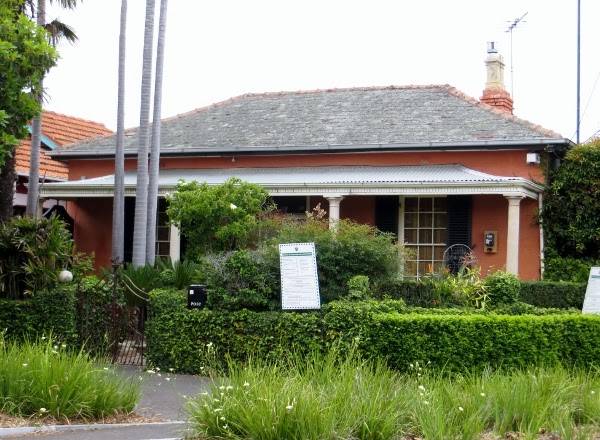
Cottage on the corner

PMHPS has observed a notice of application for a planning permit for this house on the corner of Nott and Farrell Sts, Port Melbourne.
Morley's Cottage: cnr Nott and Farrell Sts, Port Melbourne
This is where William Morley lived. He was the the first chairman of Sandridge when it became a municipality separate from Melbourne in 1860. He was mayor in 1867 and remained a Councillor until his death in 1877. You may have seen his name before - on the Bay St frontage of the former coal store now occupied by South Pacific Gym. Morley was a coal merchant and carter. The coal store, built out of bluestone, gives an indication that Morley was successful businessman.
Read more about Morley, the circumstances of his election and his family life in
The Borough and Its People: Port Melbourne 1839 to 1939 by Margaret and Graham Bride pp 82-84

Thursday, December 12, 2013

One of a kind - Port Melbourne Railway Station

This week a Planning Panel has been meeting in Port Melbourne to hear submissions on the planning future of 1 to 7 Waterfront Place.
The relationship between the proposed development of that site and the Port Melbourne Railway Station is one of the matters being considered. The building is on the Victorian Heritage Register (VHR) which is for places of significance to Victoria. The City of Port Phillip heritage register is for places with local heritage significance. This reminds us that the Port Melbourne Railway Station is an important place for Victoria and the citation explains why:
'The former Port Melbourne Railway Station building is historically significant by association with the first public steam railway in Australia, and with the development and use of the Port Melbourne piers. The building played an important role in the history of the piers, in particular Station Pier, and in the social history of Melbourne with its association with the popular bay excursion trade.
The former Port Melbourne Railway Station building, which was rebuilt at a time when the function of the piers was expanding, is significant in demonstrating a critical change in the maritime activity of the Bayside area. Its significance is further enhanced by the fact that, unlike the piers, it has not been dramatically altered throughout the twentieth century. The former Port Melbourne Railway Station building is of architectural and historical significance as a distinctive building type, the only surviving representation within the metropolitan context of a small group of station buildings developed by the Victorian Railways Department following the 1890s depression. The significance is enhanced by the integrity of its building fabric.' (Statement of Cultural Heritage Significance VHR HO983)

The City of Port Phillip's expert heritage witness Anita Brady of Lovell Chen argued that
'For both proposals, there will be impacts on the VHR listed station building arising out of the close proximity of substantial new development. While the impacts vary, both proposals still represent an unacceptable outcome for the heritage listed railway station building. Both proposals also have new building components extending in the VHR extent of registration of the railway station, which are not consistent with the heritage values and character of the railway station, or of maintaining an appropriate setting to the station. Constructing these elements in the VHR registered land would require a permit from Heritage Victoria and not from the responsible authority (the Council)

Wednesday, December 11, 2013

Beginning and ending: Holden

Today, after weeks of uncertainty but with an increasing sense of foreboding, Holden announced that it will cease to make cars in Australia from 2017. Holden, Port Melbourne, Fishermans Bend - inseparable. This is where Australia began its journey into automobile manufacture and where it will end. There will be much more said, but PMHPS wanted to mark this sad day - the implications of which will be felt throughout Victoria in the years to come. 2,900 jobs will be lost: 1600 in Adelaide and 1300 in Victoria. Read GM's media release.


Thursday, December 5, 2013

More tales from the Bend

Whenever PMHPS speaks with people who grew up in Port, tales from the Bend emerge. It seems that the Bend offered the best kind of adventures a boy could have. (Girls weren't allowed down there). Boys roamed about in a way that would not be permitted in our safety preoccupied world. Many of these stories start with getting on the bike. Fun and fascination included being able to watch ships on the river from the elevation of scrapheaps, and messing about in the swampy wetlands for tadpoles. And how about this ... going down to the abattoirs at the bottom on Ingles St at the weekend and riding the sheep. Apparently animals were held there over the weekend before being slaughtered.  A mother's 'Where have you been!?' would have been a rhetorical question.
The abattoir occupied 5 1/2 acres near the river: 686' frontage to Lorimer, 570' to Hartley , 850' to Boundary St and 112' to Harbor Trust Street.
In tougher times, people would go down to the abattoir for sweetbreads and sheep's hearts. Hughie Sykes, a coalie from Montague would come home at lunch time with a bag full.
This 1872 map is faint, so to get your bearings, the abbattoir is shown inside the rectangle close to the river at the top of the map and Ingles St is the straight road that intersects the railway line. You can also see how little development there was west of the railway at that time and that there were absolutely no obstructions between the railway line and the river.

Source
Jubilee History of the Melbourne Harbor Trust compiled from the original records of the Trust and from the Victorian Hansard /​ by Benjamin Hoare

Does anyone know when the abatoir closed?  Do you have a Bend story? 

Thursday, November 28, 2013

'A sodden expanse' - Fishermans Bend

PMHPS continues to be preoccupied with Fishermans Bend. In the late 1930s Fishermans Bend was on the cusp of a major transformation to industrial development - a change that was anticipated with excitement and optimism. Charles Daley in The History of South Melbourne says:
'The once-despised Fishermen's Bend - a no-man's land - under the pressure of economic circumstance, has come into its own, and its sodden expanse bids fair, under the exercise of human knowledge, skill and labour, directed to its reclamation, to provide eventually scope for great projects and undertakings conducive to the advantage of the State.
In this long-neglected and unoccupied area of 'Siberia,' ... great activity and interest have been aroused. On 5th November, 1936, occurred on, the north side of 'The Bend,' the opening of the great and extensive factory for motor construction of the noted firm of General Motors-Holden's, whose enterprise has set the example for other leading industrial ventures and subsidiary factories.
The Aircraft Factory ... in which the Broken Hill Proprietary, Imperial Chemical Industries and General Motors Companies are jointly concerned, has been established, and many applications have been made for leases on what must become a manufacturing area of great importance, giving employment to thousands of workmen.' (p344)
Rootes Factory in Salmon St
Harold Paynting Collection State Library of Victoria

The photograph above shows the Rootes factory under construction. The extensive plant covered almost an entire block and became the headquarters for manufacture of aircraft (principally the Beaufort bomber) by the Department of Aircraft Production during WWII. It reverted to car manufacture after the war.*

Source
*Port Melbourne Walk booklet produced but the Art Deco & Modernism Society 

Three . . . of Port

Sometimes you just can't find the right word. Take icon, for example. Many Port Melbourne people have had enough of the word 'icon'. 'Iconic' as new developments are often described, is almost guaranteed to get people's backs up.
But back to Port. In this photograph, three Port (what word would you use?): the beacon, the newly restored Stothert & Pitt crane and the chimney of Harpers Starch Factory. Icons of Port. They so clearly show how history gives meaning and identity to a place. At one time, the Starch Factory chimney was the landmark, but as this photo shows, it is now dwarfed by the hmas apartments.
the beacon, the crane and the chimney
Stothert & Pitt were 'cranemakers to the world', based in Bath, a place more usually associated with Jane Austen. The two 3-ton Stothert and Pitt electric wharf cranes with 80 foot operating radius were erected at the outer end of Station Pier in 1949.
The Jubilee History of the Melbourne Harbor Trust shows these cranes on Station Pier in a 1927 photograph - an earlier type?

from the Jubilee History of the Melbourne Harbor Trust
Corrections and additions always welcome.


Wednesday, November 20, 2013

Fishermans Bend - the past and the future

PMHPS's head is spinning with thinking about its submission to the Fishermans Bend Urban Renewal Area Draft Vision, so this week's post is about .... Fishermans Bend!
PMHPS will argue that an understanding of the environmental/natural history of Fishermans Bend is fundamental to planning for its future. So lets look at this 1864 map before the Coode Canal went in and altered the course of the river.
See the swamps and sandy terrain, the relationship to the Yarra River, the emerging city and the Sandridge township.


This is how one resident, writing in 1935, recalled the area:
'Fishermans  Bend was a fine place, almost in its primitive state, a great resort for sportsmen, rabbits, wild duck and other game being plentiful. Thick tea tree scrub grew on the south side of the Yarra from the present timber dock almost to the mouth. Three prison hulks were moored in a backwater since reclaimed half way over to Spotswood. A jetty ran some distance in to deep water on the south side, and the prisoners would row over to get supplies brought from the city. The Bend was a fine grazing ground; hundreds of cows and horses were grazed there paying so much a head to the local council, which employed a herdsman. The position was held by Mr Anthony Rodgers. Fishermens houses occupied the beach frontage almost to the mouth of the Yarra' (Sandridge recalled Age 9 2 1935)

Thursday, November 14, 2013

Fishing business

Dugga Beazley
In the late 1980s, with great change looming in Port Melbourne, Dugga Beazley spoke to documentary maker Richard Crawley of his fear that a time might come when he would no longer be able to run his fishing business from Dow St. That time seems to come every few years when newcomers complain about his business or his trailer. Once again, his operation is under threat after the Council's crackdown on trailers being kept on the street.
The Beazleys have fished in Port Melbourne since the earliest days of white settlement. Dugga Beazley knows the Bay like few people alive know the Bay - its fish, its winds, its currents, its moods. He knows details about the history of the Bay - the storms, the wrecks, the boats. He has been fishing since he was 13 years old - 60 years on the Bay.
He is a very proud Australian, and one of his proudest moments was leading the flotilla of boats up the Yarra River for the Commonwealth Games.
We invest heavily in protecting our built heritage but don't seem to have the means of celebrating and protecting our living heritage. We should be nominating Dugga as a living treasure rather than hounding him off the street. Keep him on the street where he can share those stories rather than locking him away behind a wall. We have so much to learn from him - lived knowledge you can't find on an iPad or in a book.
Every boat he paints has a story – many that begin right here in Port. Once he was painting The Volunteer. 
The Volunteer was built by Jesse William Merrington at 121 Liardet Street* around 1920 and 21. It was originally owned by the Merrington brothers before being sold to George Beazley. Merrington's boat shed was located on the shores of the Sandridge Lagoon** A further boat, The Enterprise was built off the moulds of The Volunteer at 41 Nott St, Port Melbourne during mid 1930.
'Oo roo' as Dugga would say.
Sources
Re-Living the Early Days, The Age 2 February 1935
Ida Campbell writes in (an unnamed) newspaper 27 January 1983
Dugga Beazley
* also known as Kyme Place
**where the pumping station is now on Esplanade West

Thursday, November 7, 2013

Port in the twenties - a difficult, suffering place

Former Supreme Court Judge Frank Vincent is such a fine speaker. He talked about Whittaker in the Port Melbourne and wider social and political context of the late 1920s. In case you missed his speech at the Allan Whittaker commemoration on Friday 1st November, this is what he said:

"Port Melbourne in the twenties was a place of considerable poverty.  It was a place where men were engaged in what was regarded as the most menial of labour possible in the community and the area was regarded as one of those to which no one would ever aspire.The depression hit early in Port Melbourne and it hit very hard, and it hit particularly the members of the two waterside worker unions that operated in this region. They both suffered because there were reducing cargoes well before the depression actually was recognised and there was a militant effort by shipowners to reduce the conditions under which they had to work and live at that time.
So it was of its very nature a very difficult and increasingly difficult environment for them. The men who gathered at Hogans Flat had been waiting for a vessel to arrive so that they were eligible for the pick up. There was a real effort at that time by the shipowners to have the pick ups conducted twice a day so that you had to be available virtually all of the time.
The men who came down on the 2 November had been assembling for four successive days without being picked up at all. Among them was Allan Whittaker. Allan Whittaker was not a well man. When he was subsequently admitted to hospital following receipt of the gunshot that actually killed him, he was described by the doctors as underweight and malnourished.  The people here were very close to starving, and he was one of them.

Although there was anger and there was violence among the men who gathered that day, and that can’t be put to one side, there was a very different level of violence employed by the police. And of course Whittaker was not a man himself who would have been involved in any of the violent acts because he simply would not have been well enough. Apart from anything else, he limped fairly badly because of the gun shot that he had received at Gallipoli some twenty odd years earlier.

So picture it. Here’s a man malnourished, underweight and on the only accounts that we have of what occurred at the time he was standing on the extreme edge of the group and to the rear. He was shot. He was shot according to the coronial inquiry from the front. That is highly unlikely to have been the case. Only a very very poor inquiry was ever conducted into that matter. This was not a shooting by the police that the authorities wanted investigated genuinely at all. So he never achieved justice during his lifetime and only very limited recognition in the years to follow.

But his story, and who he was, and what happened on that day impacted very powerfully upon the Port Melbourne community.Now I was born into that community only eight years afterwards, and it was still a poor difficult and suffering community at that stage.  It was a place of considerable poverty. And of course I was born into a waterfront family.

But the remarkable thing about what occurred at that time, and which is not simply the story of one man, is that there was a bonding, a linkage between those people who remained with the Waterside Workers Federation in the very very difficult period of almost twelve years that followed that particularly shooting.  Because quite a few defected. Quite a few left the industry entirely.

Those that remained, those that lived in this area of Port Melbourne, formed a very very powerful community and a community that had its effect right across our industrial scene for the many years that followed.
I don’t think anyone should underestimate the significance of the struggles which occurred at that time. The courage that it took for men and women to hold together when they could easily have joined a scab union and defected and given away their principles and given away their community.
But they didn’t do that. And it took a very special kind of courage and it ought to be memorialised, it ought to be understood, we ought to be inordinately proud of it.

There are lots of things in our Australian history of which we should be massively ashamed - some of them are occurring at the present time - but this is certainly not one of them."


Allan Whittaker Commemoration at Princes Pier, Port Melbourne
1 November 2013

Sunday, November 3, 2013

A Melbourne Cup Special

Melbourne Cup Day prompts this recollection from member Helen Barry:

“Mum was a milliner. She was busiest at racing time. I always went to the Melbourne Cup with her. We used to walk past the members’ enclosure trying to spot the hats she had made.”

Rose with her future husband, Norman Barry 
"Rose Welsh began her apprenticeship as a milliner at Susanne et Cie at 179 Collins St, Melbourne in 1925.  She was lured by the high class milliner Thomas Harrison, known as ‘the Czar of the Millinery world’ to his shop and workroom at De Vere et Cie, the Block Arcade, 262 Collins Street. She became ‘head of the table’ as they called it. She worked with him for ten years until she married.  By the time she left De Vere she was the overseer of the girls making the hats and regarded as a leader in her profession.  Thomas Harrison held her in high esteem and presented her with a silver tea and coffee service on a large silver tray which was openly displayed in the showroom of De Vere for the customers to admire. She used to take hats in hat boxes on the cable trams to customers through the city. On one occasion, she stitched a hat to a client's head using her hair. It was to look as though the wind had blown it onto her head.

After her marriage Rose - now Barry - worked from home for Lola Canning in the Block Arcade. She made hats from her Garden City home well into her 80s. Her last employer was Wendy Mead who worked out of Toorak. She made hats for Lillian Frank and Pixie Skase. Wendy Mead would tear out a page with a hat on it from Vogue and Mum would then make it. Many a hat was shaped around this wooden block. After mum had made the hats, dad would deliver them.”
Explore further
Visit the National Gallery of Victoria's on-line gallery of the hats of Thomas Harrison. Rose Barry's hand may well have been at work in some of those hats http://www.ngv.vic.gov.au/col/artist/9610

Wednesday, October 30, 2013

A bit early?

Olive's Corner, Port Melbourne

Walking through Olive's Corner earlier this week, saw a person reading the PMHPS book 'Chartered Scoundrels: A Brief History of Port Melbourne Hotels'. Couldn't let this go unremarked and stopped for a chat.
Robert Gooding enjoys visiting Port. By 9 am he had already taken two buses and a train to get here. With the book and his camera, he was looking forward to a morning's wandering around the Borough.
As you would know, the 2014 PMHPS calendar also features historic Port Melbourne hotels and is available at the Port Melbourne Town Hall and the newsagent.

Monday, October 28, 2013

Allan Whittaker Memorial Commemoration

Update 3 November 2013
At sunset people gathered at Princes Pier to commemorate the life of Allan Whittaker, shot by police in the waterfront dispute in 1928. Kevin Bracken emphasised the importance of getting together to tell the stories of the place and the people that have shaped Port Melbourne. 
Former Supreme Court Judge Frank Vincent, who was born into a waterfront family in Port Melbourne in the thirties gave an impressive address - all without notes. Here is a brief excerpt from his speech (for more, click here)

 Frank Vincent, born in Port Melbourne
"But the remarkable thing about what occurred at that time, and which is not simply the story of one man, is that there was a bonding, a linkage between those people who remained with the Waterside Workers Federation in the very, very difficult period of almost twelve years that followed that particularly shooting.  Because quite a few defected. Quite a few left the industry entirely.
Those that remained, those that lived in this area of Port Melbourne, formed a very very powerful community and a community that had its effect right across our industrial scene for the many years that followed.
I don’t think anyone should underestimate the significance of the struggles which occurred at that time. The courage that it took for men and women to hold together when they could easily have joined a scab union and defected and given away their principles and given away their community.But they didn’t do that. And it took a very special kind of courage and it ought to be memorialised, it ought to be understood, we ought to be inordinately proud of it.
There are lots of things in our Australian history of which we should be massively ashamed - some of them are occurring at the present time - but this is certainly not one of them."


The Allan Whittaker Memorial Commemoration will be held at Princes Pier on Friday 1st November at 6.15 p m.
The commemoration will mark the 85th anniversary of the 1928 Dock Strike and fatal shooting by police of Allan Whittaker, a waterside worker and Gallipoli veteran.
The commemoration will feature talks as well as the sunset presentation of memorial items to commemorate Allan Whittaker, his fellow waterside workers and rich maritime industrial history.
(PMHPS warrants that this is a photograph taken of a notice about the Whittaker commemoration and is not contrived)

Wednesday, October 23, 2013

Metropolitan Planning 2: Entering Melbourne from Port Melbourne

The Town Planning Commission report of 1929 was very critical of the entrance to Melbourne from Port Melbourne. It reported that 'this approach to Melbourne is a drab and shabby one'.  The honorary secretary of the Commission, Frank Heath, said hopefully 'What a difference a tree lined boulevard, extending for several miles around the esplanade would make to the Port Melbourne waterfront.'
The appearance of Port Melbourne's foreshore also attracted a lot of commentary in the papers of the day along these lines: 'Run your eye along the waterfront scene, and you will realise that the overseas tourist's first impression of Melbourne is one of aesthetic horror.'  Perhaps there is just a hint of exaggeration in the following description: 'The scene which greets the visitor leaving Princes Pier might well serve as the background for a theatre set representing a specially unpleasant corner of American desert country'
So successive dignitaries and royals were taken from Port to St Kilda so they could proceed with appropriate dignity up St Kilda Road. This still rankles. However, the picture of Swallow St in the Town Planning Commission report suggests they had a point.

The Port Melbourne Council maintained that the land between the piers was the Melbourne Harbor Trust's responsibility. The MHT said what happened on the landward side was not their responsibility.Throughout the 1920s the Port Council lobbied the Government for improvements to the waterfront. Finally the Melbourne Harbor Trust proposed a bridge to link the two piers. Centenary Bridge was built for the Centenary of Melbourne in 1934 but roads connecting to it were not completed and open to the public until 1936.
All that remains of that unique structure is the lone pylon opposite the London Hotel. Look for the Melbourne Harbor Trust monogram on the pillar. Centenary Bridge was demolished to make way for the Beacon Cove development in 1991.
Once again the area around the Piers is the subject of discussion by the Council and the Port of Melbourne Corporation.

Cautionary tale: the quotes above are taken from a photocopied compilation of newspaper articles, some of them undated. If you ever cut anything out of the paper (an act that in itself may soon become a historical exercise) write the date and source on it in pencil straight away. Without accurate dating, they are less useful.
Sources, notes and further information
The Melbourne Harbor Trust is the antecedent organisation of today's Port of Melbourne Corporation
Please read the fabulously detailed account of the stories surrounding the construction of Centenary Bridge at
G & M Bride The Borough and Its People, Port Melbourne 1839 to 1939


Monday, October 21, 2013

Launch of the ANZAC Centenary at Princes Pier: a time for re-connection


In a way it was fitting that it was a grey and rather sombre day for the launch of the ANZAC Centenary commemorations at Princes Pier. Today marks the day 99 years ago that the HMAT Orvieto departed from then Railway Pier in Port Melbourne. The Orvieto troop ship was the lead ship in the convoy to Albany, and then again led the convoy to the Middle East. Ted Baillieu, chairman of the ANZAC Centenary Committee, spoke of the moment of enlisting as a moment of dis-connection - when people separated from families, friends and communities. The ANZAC Centenary project is an opportunity to re-connect through personal and family stories to the shared history of the First World War.
A descendant of one of the soldiers on the Orvieto has gone on just such a journey into his father's past. At this distance he can only imagine what motivated his father to volunteer in those early days of the war. He referred to the amazingly extensive and accessible resources available to any person inquiring into their family history. They are available to us all.
PMHPS has made a list, for further exploration, of all those on board the Orvieto who gave a Port Melbourne address. (Of course, they are also available through the embarkation lists below).A brief scan suggests that Albert Street had most people on board.

Sources
ANZAC Centenary: Sharing Victoria's Stories
http://www.anzaccentenary.vic.gov.au
Embarkation of the Orvieto: including embarkation lists and images
http://www.anzaccentenary.vic.gov.au/remembrance/hmat-orvieto-embarkation
Herald Sun 21 10 2013

Its History Week from 20 to 27 October

What better way to celebrate History Week than to visit the City of Port Phillip's brand newly opened Emerald Hill Library and Heritage Centre in the former Post Office opposite the South Melbourne Town Hall.
If you can't get there for any reason, there is plenty to explore on the City of Port Phillip's Heritage Website http://heritage.portphillip.vic.gov.au/Home
If you are out and about in Victoria, there is a huge amount on. For a calendar of events, visit http://www.historyweek.org.au/events-search.php

Wednesday, October 16, 2013

Metropolitan Planning

Last week, Premier Napthine and Planning Minister Guy released Plan Melbourne which sets out the government's vision for Melbourne to 2050.
In the Society's collection is a copy of the first plan for Melbourne prepared by the newly formed Metropolitan Town Planning Commission in 1929. While the whole report is full of interest, unsurprisingly PMHPS headed straight for the Port Melbourne references. The report is also available online, downloadable chapter by fascinating chapter.
By 1929,  a considerable number of the Garden City Bank houses had been completed or were under construction, as can be seen in the photographs below. (The book is quite fragile so it couldn't be opened fully) Can you help in identifying some reference points?
Garden City Bank houses under construction
Brand new but treeless Crichton Avenue
Of particular interest are references to places still topical or in contention today. The further development of Fishermans Bend was contemplated in the Plan as follows: 'Fishermans Bend aimed at the creation of an industrial suburb of which 340 acres were planned for residential development, 420 acres for industrial purposes and over 80 acres for open space and playing fields.' (p254)
More about the 1929 Plan next week . . .

Further information
History of Strategic Planning in Melbourne
http://www.dpcd.vic.gov.au/planning/plansandpolicies/planningformelbourne/planninghistory